
Solution
Aerostat
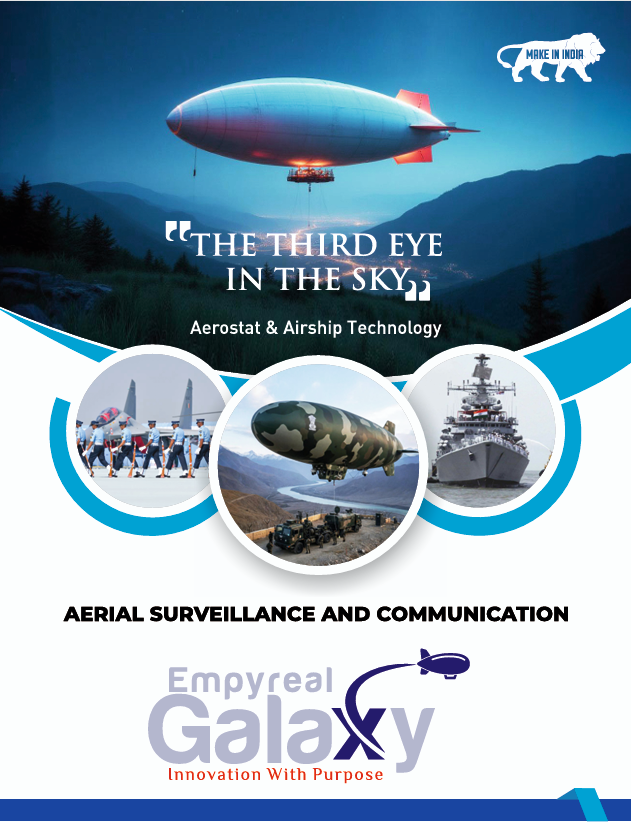
An Aerostat System is a tethered lighter-than-air aerial platform that remains airborne using helium and is anchored to the ground through a tether system. Designed for persistent surveillance, communication, and reconnaissance, aerostats provide a stable elevated vantage point for carrying payloads such as EO/IR cameras, radar systems, communication relay equipment, and other mission-specific sensors. Compared to conventional aerial platforms, aerostats offer the advantage of long endurance, wide-area coverage, low operational cost, and rapid deployment, making them ideal for applications such as border security, coastal surveillance, disaster management, critical infrastructure monitoring, public safety, and telecom support.
Globally, aerostat systems are gaining renewed importance as governments, defence organisations, and infrastructure sectors increasingly look for cost-effective and persistent aerial monitoring solutions. Advances in lightweight materials, tether technology, payload integration, autonomous control systems, and hybrid power solutions are enabling modern aerostats to perform a much wider range of missions than ever before. Today, aerostat platforms are being explored not only for surveillance and reconnaissance, but also for communication restoration, remote area connectivity, environmental observation, and future non-terrestrial network applications, positioning them as a vital component in the evolving global aerial systems ecosystem.
Solution
Airship
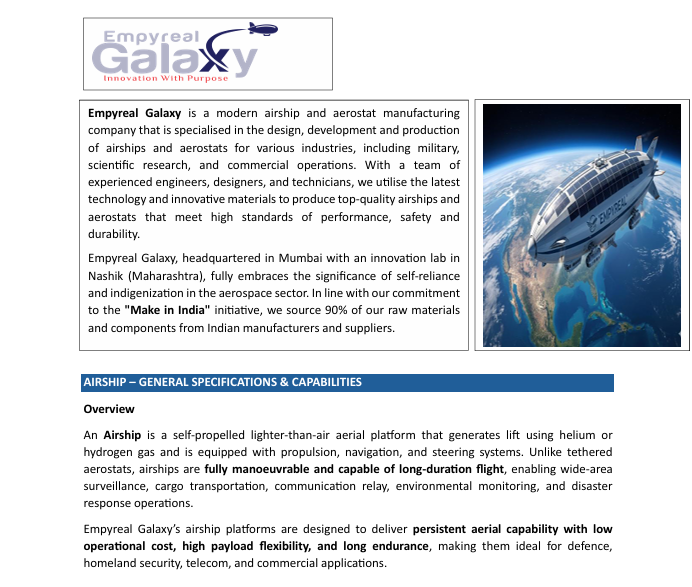
An Airship System is a self-propelled lighter-than-air aerial platform that generates lift using buoyant gases such as helium or hydrogen and is equipped with propulsion, navigation, and flight control systems. Unlike tethered aerostats, airships are fully manoeuvrable and capable of long-duration flight across wide operational areas, making them suitable for missions that require both endurance and mobility. Airships can be configured to carry a wide range of payloads including surveillance sensors, radar, communication relay equipment, cargo modules, environmental monitoring instruments, and specialised mission systems, offering a highly versatile aerial platform for both civil and strategic use.
Globally, airship technology is witnessing renewed attention as industries and governments explore alternatives to conventional aircraft for persistent surveillance, cargo transportation, disaster response, communication support, and sustainable aviation applications. Advancements in lightweight envelope materials, hybrid propulsion, autonomous navigation, modular payload integration, and energy-efficient operating systems are making modern airships increasingly viable for real-world deployment. Their ability to deliver high payload capacity, lower operating cost, reduced noise, and long endurance positions them as an emerging solution for future aerospace, defence, and commercial mobility ecosystems.
Solution
High Altitude ISR Platform
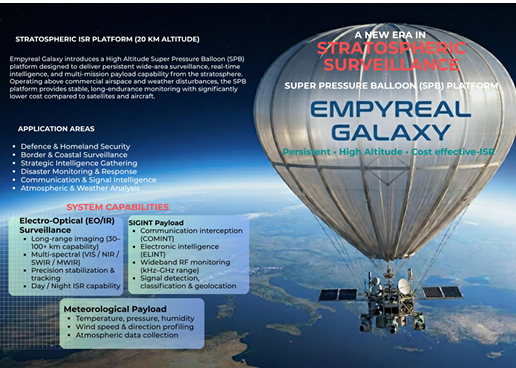
A High Altitude ISR Platform is a lighter-than-air aerial system designed to operate in the stratosphere, providing persistent wide-area Intelligence, Surveillance, and Reconnaissance (ISR) capability from extreme altitudes. Positioned well above conventional air traffic and weather disturbances, these platforms are capable of carrying advanced payloads such as electro-optical sensors, infrared systems, SIGINT/ELINT equipment, communication relays, and atmospheric monitoring instruments. Their elevated operational profile allows them to cover large geographic areas continuously for extended durations, making them highly valuable for strategic surveillance, border and coastal monitoring, communication support, disaster observation, and intelligence gathering missions.
Globally, High Altitude ISR Platforms are emerging as a critical part of the future aerospace and defence landscape, bridging the capability gap between satellites, UAVs, and conventional airborne systems. Nations and technology developers worldwide are investing in such platforms to support persistent ISR, resilient communication networks, real-time situational awareness, and next-generation aerial infrastructure. With the growing focus on cost-effective wide-area monitoring, AI-enabled surveillance, and future non-terrestrial communication systems, High Altitude Platforms are increasingly being recognized as a strategic force multiplier for both military and civilian applications.